
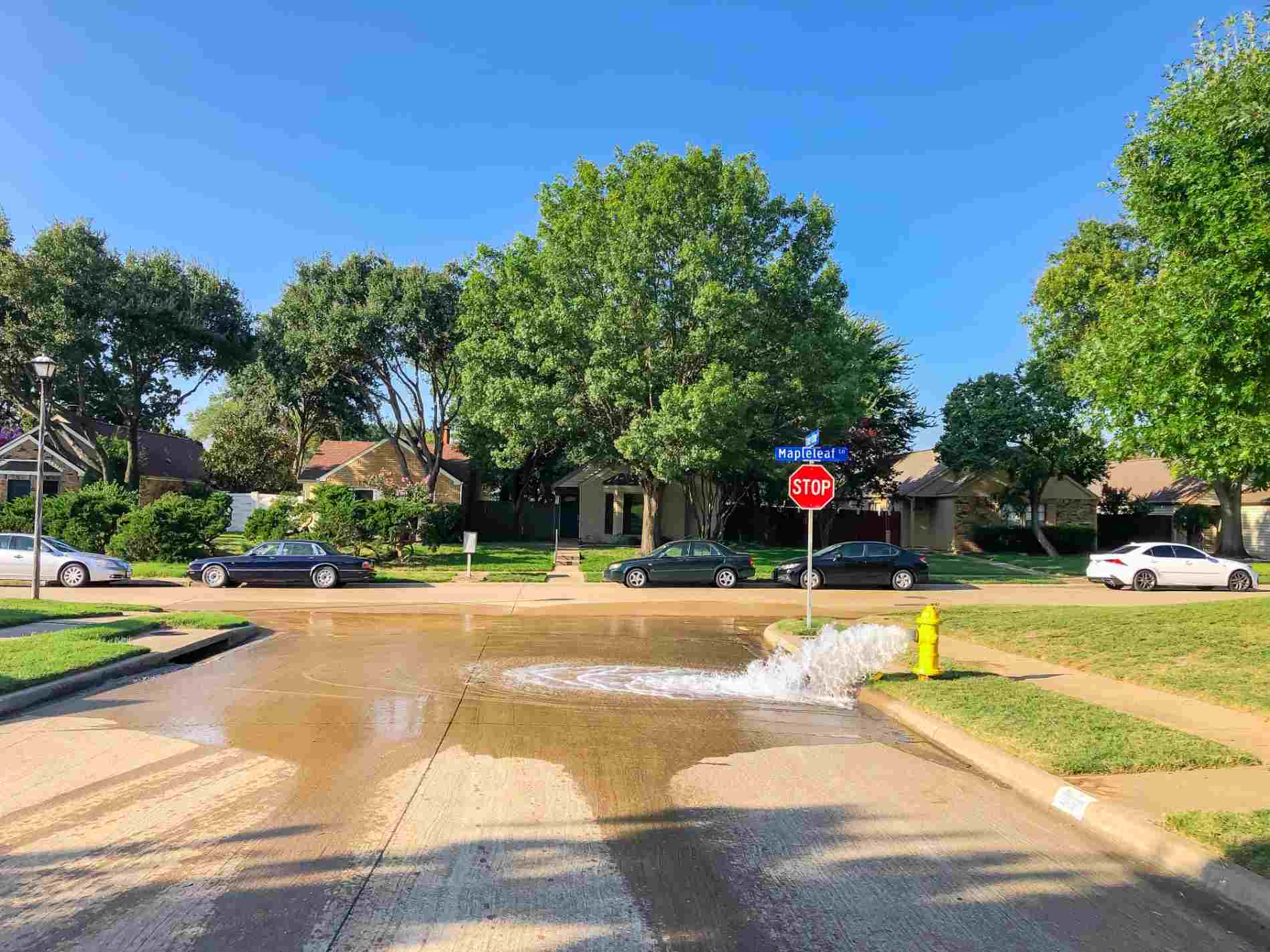



How water utilities plan a hydrant flushing program: flushing methods, velocity targets, crew work orders, customer notices and the records to keep.
For US Utilities serving 3,000-100,000 meters and for operations team, billing team and utility managers. For Heads of Billing who own collections accuracy and revenue leakage.
Hydrant flushing is the practice of opening fire hydrants to move water through distribution mains fast enough to remove sediment and stagnant water and to restore disinfectant residual. A hydrant flushing program plans that work by zone, sends crews out on scheduled work orders, notifies customers before discolored water reaches their taps, and records what crews find. Many utilities run it from the same water utility management software that holds their hydrant, valve and customer records.
Water does not move evenly through a distribution system. In dead-end mains and low-use areas it sits longer, and the EPA's water age fact sheet explains that older water gives chlorine more time to be consumed, which can allow microbial growth and raise disinfection byproduct levels. Particles and corrosion products also settle in pipes as sediment.
Flushing addresses both problems. The EPA's distribution system flushing fact sheet lists these benefits:
The same fact sheet notes a limit: depending on method and velocity, flushing may only exchange the water, or may loosen sediment without removing it. That is why the method and the flow rate matter as much as the decision to flush.
Utilities flush on a schedule, as routine maintenance, or in response to a problem such as low residual, a positive coliform result or a run of discolored water complaints. The EPA describes scheduled flushing as part of a preventive maintenance program and unscheduled flushing as a response to complaints or water quality changes, the same split covered in the guide to proactive vs reactive maintenance for water utilities.
Which flushing method fits each part of your system?
The EPA fact sheet describes flushing programs as scheduled or unscheduled, comprehensive or targeted, and conventional or unidirectional. Most utilities combine more than one method.
Unidirectional flushing is the method most programs build toward. A Tata & Howard white paper on UDF explains that conventional flushing moves water in all directions, takes longer and uses more water, while UDF moves water one way, from larger and cleaner mains to smaller and dirtier ones.
What has to be ready before the first crew opens a hydrant?
The EPA fact sheet and the Tata & Howard white paper give a consistent order of work. A first-year program usually follows these steps:
The EPA also suggests coordinating flushing with valve exercising and hydrant testing, since all three put crews at the same valves and hydrants.
Velocity is what removes sediment. The Tata & Howard paper cites AWWA guidance of a minimum velocity of 3.0 feet per second for UDF, and a minimum of 20 psi of system pressure in the area around active flushing to protect fire flow.
The flow needed to reach 3.0 feet per second depends on the size of the main. The figures below are calculated from nominal pipe diameter; actual inside diameter varies with pipe material and age, so use your hydraulic model for each run.
The 8-inch figure matches the white paper's example of just under 500 gpm. If a run cannot reach its target flow, check it against the model before flushing, since the cause is often a closed valve or a main that differs from the map.
A flushing program is a series of field jobs, each tied to specific hydrants and valves. Treating every run as a work order gives the utility a schedule, an owner for each job, and a record that can be compared year to year. The Tata & Howard paper stresses recording flow, pressure, valve operations, start and end times, and whether the flushing hydrant was throttled.
When a crew finds a valve that will not close, does that problem become a repair job the same day, or a note nobody reads?
Mobile work orders let crews record readings at the hydrant instead of on paper forms that are typed in later. For how utilities assign, track and close field jobs, see the guide to work order management for water utilities.
Flushing can briefly lower pressure and stir up sediment that reaches customer taps. Notices before crews arrive let customers plan around the work, such as holding laundry until the water clears. A clear notice covers:
Utilities use several channels at once: mailed zone notices, door hangers, automated calls, text and email alerts, and a web map. Portland Water Bureau, for example, publishes where flushing is happening on an online map and tells residents that its crews usually work weekdays from 8:00 am to 4:00 pm, while its automatic flushers typically run at night.
Notices are one part of keeping customers informed during field work, a topic covered more broadly in the guide to improving customer experience at a water utility.
Automatic flushers handle the spots crews would otherwise visit again and again. They attach to a hydrant or blowoff and open on a programmed schedule to turn over water in low-use areas.
The EPA flushing fact sheet gives a small-system example: a utility serving 6,000 people struggled to keep a disinfectant residual above 0.1 mg/L at the far ends of its system. It installed automatic flushing units in three problem areas, and free chlorine residual rose above 0.2 mg/L in those areas. Portland Water Bureau describes its autoflushers as programmed to run for specific amounts of time in neighborhoods where water quality needs regular attention.
Automatic flushers do not remove the cause. The EPA water age fact sheet lists design fixes such as eliminating dead-end mains by installing pipe to form a closed loop. Flushers are often the interim measure while that work is planned.
Flushing tests the distribution system as well as cleaning it. Flow and pressure that do not match the plan usually point to a specific problem, and the Tata & Howard paper notes that differences in flow from year to year should be investigated.
Closed valves are a real risk. The EPA water age fact sheet describes a large system that found 44 isolation valves closed during maintenance and never reopened, which led to high water age and coliform problems until valves were repaired and the area was spot flushed.
Hydrant records matter here too. Every hydrant should be in the asset inventory with its location and condition, including hydrants on private property; the guide to private hydrant billing covers how utilities set those up as a billable service.
SMART360 by Bynry is a cloud platform for water, electric and gas utilities serving 3,000 to 100,000 accounts. For a flushing program, the relevant parts sit in one system:
SMART360 connects to other systems through 25+ pre-built integrations, more than 50,000 accounts are live on the platform, and customer retention is 95%.
See SMART360 in Action. See work order and field service management in SMART360, from scheduled job to closed repair.
Hydrant flushing is opening fire hydrants to move water through distribution mains fast enough to remove sediment and stagnant water and to restore disinfectant residual. Utilities do it on a schedule as routine maintenance or in response to water quality problems.
It depends on the goals and the system. Many utilities flush the whole system on a yearly cycle and flush problem spots more often. The Tata & Howard UDF paper notes that annual unidirectional flushing helps prevent sediment and tuberculation buildup.
Unidirectional flushing (UDF) closes selected valves so water moves one way, from a clean source toward the flushing hydrant. The EPA says this limits the spread of sediment and produces higher velocity than conventional flushing.
Flushing uses water, but it is planned maintenance. Unidirectional flushing uses less water than conventional flushing because each run is shorter and reaches higher velocity, according to the Tata & Howard white paper.
AWWA guidance cited in the Tata & Howard white paper recommends at least 3.0 feet per second, with at least 20 psi maintained in the surrounding area. For an 8-inch main, that is just under 500 gpm.
A hydrant flushing program turns a routine maintenance task into planned, recorded work. Set water quality goals, inspect valves first, plan zones and runs from clean to dirty, hit the velocity target, notify customers, and record every run so problems become repair jobs and next year's plan improves. The water utility management software page shows how SMART360 keeps hydrant records, work orders and customer accounts together for that work.
Bynry Inc.
8 The Green STE.R,
Dover, Kent,
Delaware 19901
+1 732-630-0285
Bynry Inc.
Serene Tower, Pakharbaug
Pune, Maharashtra 411021
+91 93252-51217